Embraer Legacy 500 vs Bombardier Challenger 350
May 8, 2026
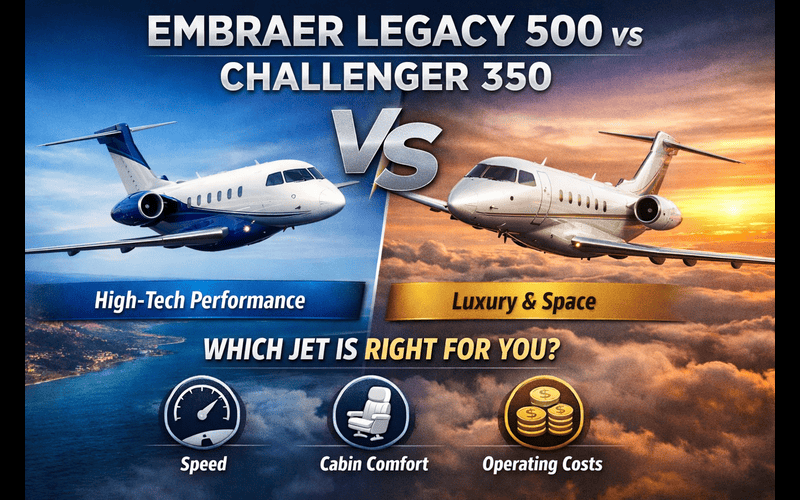
In the competitive business aviation market of today, you need to carefully weigh speed, cabin comfort, and running costs to find the best super-midsize jet. AviaCost and other sites like it help buyers and owners compare planes by showing specific information about their costs and performance. This helps you pick between top jets like the Bombardier Challenger 350 and the Embraer Legacy 500.
One can fly across continents, the other has a stand-up cabin, and both are the best in their class. But their approaches to planning and maximising goals are not the same.
What Are the Key Differences Between the Legacy 500 and Challenger 350?
The Legacy 500 is more concerned with advanced technology and a wide range of routes, while the Challenger 350 is more focused on cargo space and cabin space. They can both carry 8 to 12 people and go more than 3,000 nautical miles, so they can both be used in the same area.
Performance Comparison
Range and Speed
Challenger 350
Range: ~3,200 nm (≈5,926 km)
Max cruise: ~470 knots
Legacy 500
Range: ~3,125 nm
Cruise speed: ~466 knots (≈536 mph)
What this means:
The Bombardier Challenger 350 has a slight edge in range and top speed, giving it marginally longer nonstop mission capability.
Takeoff and Airport Performance
Legacy 500 takeoff distance: ~4,084 ft
Challenger 350 takeoff distance: ~4,835 ft
Operational Insight:
The Legacy 500 can operate from shorter runways, making it attractive for regional airports or constrained locations.
Cabin Comfort and Interior Space
Cabin Dimensions
Challenger 350
Cabin width: ~7.2 ft
Cabin volume: ~860–930 cu ft
Legacy 500
Cabin width: ~6.8 ft
Cabin volume: ~823 cu ft
Interpretation:
The Challenger 350 offers a wider cross-section and slightly more cabin volume, translating to a roomier feel for passengers.
Passenger Experience
Embraer Legacy 500 features a flat-floor stand-up cabin and modern ergonomic layout.
Challenger 350 seats can convert into fully lie-flat positions for long-haul comfort.
Takeaway:
Legacy 500 focuses on contemporary design and accessibility, while Challenger 350 leans toward traditional spacious luxury.
Payload and Passenger Capacity
Challenger 350 maximum payload: ~3,400 lb
Legacy 500 maximum payload: ~2,800 lb
Passenger capacity for both jets typically ranges between 8 and 10 travelers, depending on configuration.
Mission Impact:
The Challenger 350 is better suited for heavier passenger loads or baggage-intensive corporate missions.
Technology and Flight Characteristics
Legacy 500 is known for advanced fly-by-wire controls that reduce vibration and enhance ride smoothness.
Challenger 350 incorporates upgraded Honeywell engines and aerodynamic improvements for efficiency and thrust gains.
Operational Perspective:
Legacy 500 emphasizes modern avionics innovation, while Bombardier Challenger 350delivers incremental refinement of a proven platform.
Operating Costs and Ownership Economics
Using tools such as AviaCost’s operating-cost calculator helps estimate real ownership expenses across fuel, maintenance, and hourly operation.
Legacy 500 variable operating cost: about $4,500 per hour
Annual operating budget estimate: ~$2.08 million (based on 325 flight hours)
Industry comparisons show super-midsize jets like the Challenger 350 typically fall into similar direct operating cost ranges, with acquisition pricing higher due to larger cabin and payload capabilities.
Financial Insight:
Cost differences often depend more on mission profile than headline specifications—exactly where AviaCost’s modeling tools become valuable for decision-makers.
Mission Suitability: Which Jet Fits Your Needs?
Choose the Legacy 500 If You Need:
Better short-runway performance
Modern fly-by-wire technology and smoother ride
Efficient operating profile for regional or mixed-airport missions
Choose the Challenger 350 If You Need:
Wider cabin and more interior volume
Slightly longer range and higher payload
Proven design optimized for corporate group travel
At-a-Glance Comparison
Conclusion
There are some similarities between the Embraer Legacy 500 and the Challenger 350, but they are also very different. Bombardier is more concerned with passenger space and payload performance, while Embraer is more interested in technology and flexible runways. AviaCost and other data-driven tools help make sure that the final choice is based on real business needs, not just the specs in the brochure.
FAQs
Which jet has better range?
There is a lead of about 3,200 nautical miles between the Challenger 350 and the Legacy 500.
Which aircraft offers a wider cabin?
The trunk of the Challenger 350 is bigger, which makes longer trips more comfortable for people who are riding.
Is the Legacy 500 more airport-flexible?
Yes. Because it needs a shorter distance to take off, it can work on fields that aren't very big or movable.