Can the Pilatus PC-24 Fly to Hawaii, Operate with a Single Pilot & What Does It Cost to Own One?
May 9, 2026
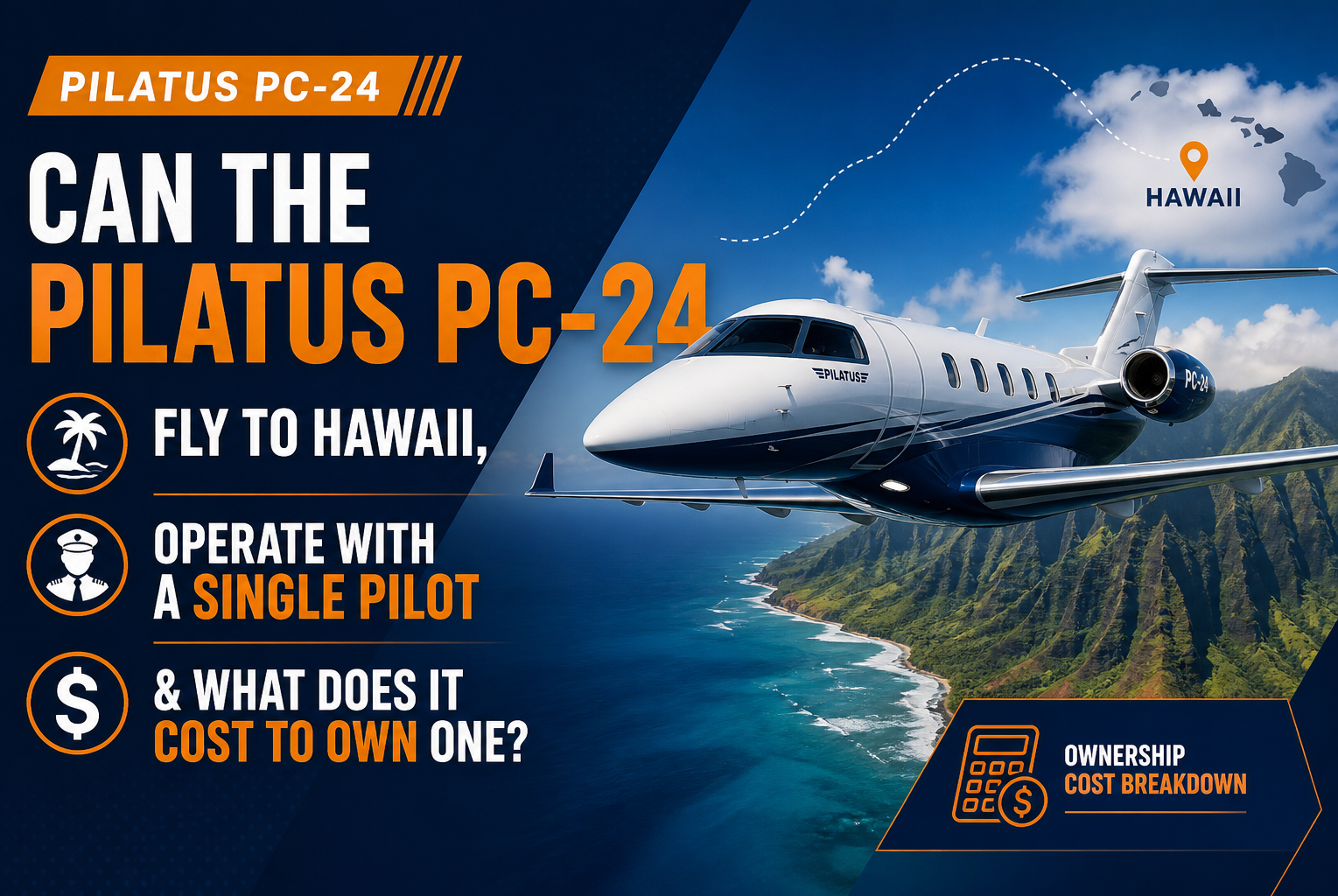
By the time folks start researching private jets, though, the Pilatus PC-24 frequently shines. It is prized for its practical, flexible and more accessible offering than a lot of other business jets. But three questions typically get asked before buyers even make any decision:
This guide addresses those questions accurately and from a perspective of what has to be done instead of brochure-level specs so you can assess if the Pilatus may work for you.
What is the differentiator of the Pilatus PC-24?
They made Pilatus PC-24, a company in which reliability and practicality are king. Unlike many light jets, the PC-24 was built to be used as and when needed in the real world under situations where airport access is limited. It is not merely the speed that has made a difference, but flexibility.
It can function on shorter runways and even unpaved lands, something almost no jets will be able to do. Hence the ability to be used by business owners, charter companies and even medical operators who have to visit locales not served by the major ones.
The cabin is meant to be utilitarian, too, with a flat floor and a generous cargo door that allows one to go on and off from passenger to cargo operations easily.
Is it possible for the Pilatus PC-24 to fly to Hawaii?
Yet the answer is one of the most searched questions — and it must have something to do with the real world. On paper, the PC-24 has a maximum range of about 2,000 nautical miles. When you first think about it this is not far away from what is required to fly across the U.S. West Coast to Hawaii.
However, in air transportation true conditions take precedence over numbers displayed by brochures. Flights to Hawaii require additional fuel reserves for safety, and wind, passenger load and routing restrictions all have limits on an aircraft’s range.
For practical reasons, the distance between California and Hawaii is typically beyond what a PC-24 can safely fly nonstop in normal operating conditions. You have odd events — such as ferry operations with an extra fuel system — where extended distance can be accomplished, but these are not typical for standard operations or business travel.
So for frequent use, the PC-24 isn't a Hawaii-capable jet. If you often fly long overwater flights on your mission, you would need to consider larger aircraft with greater range.
Can One Pilot Fly the Pilatus -24?
That’s one of the greatest benefits with it, and yes. It is certified for single-pilot operation; a qualified pilot will use the plane by themselves in both a legal and safe manner. That is a huge advantage for owner-operators and small operations that want to hold costs at bay without sacrificing capability.
The aircraft is equipped with a state-of-the-art cockpit system which works to reduce the pilot’s workload. Controls and automation are intuitive, and much of what is done is repetitive automation that the pilot can use to make decisions and keep safety first in mind. Nevertheless, the plane operates on the principle that just because it can be flown by one pilot, this doesn’t mean it always should be.
For longer flights, crowded airspace or inclement weather, two pilots provide extra safety and reduce fatigue. It’s common for corporate pilots to fly with two pilots — even when there is no need for two. Put another way, single-pilot operation works for shorter, simpler missions, but two pilots are generally better for more complicated trips.
What Does It Cost to Own an Aircraft?
All aircraft should be purchased in accordance with the ownership cost. Although you must pay for this model, the Pilatus occupies the light jet category, but the costs of this modern engine suggest otherwise.
Purchase Price
A new PC-24 usually costs in the range of $10 million to $12 million, based on customization and market demand. It’s common to find aircraft at relatively low prices when flying on a pre-owned basis, however their value will vary depending on their age, usage or condition.
Annual Fixed Costs
Fixed costs are the expenses you pay whether you fly the aircraft or not. This will include crew salaries (if you hire pilots), insurance, hangar space, training costs and aircraft management services. In the real world, these costs typically range from $500,000 to $800,000 per annum. How much depends on the location, as well as how the aircraft is managed.
Operating Costs Per Hour
Variable costs depend on how many times you fly. The primary consideration is fuel, then maintenance and engine reserves. To put it in the context of a PC-24, the operating costs are typically $2,500-$3,500 per flight hour. These costs can fluctuate based on fuel pricing and maintenance schedules.
Total Annual Ownership Cost
If you can fly about 200 hours a year — an average for many private owners — the total annual cost could go up to about $1 million to $1.3 million. Fixed and variable costs all figure out to be equal in this case. The average cost per hour if you break it down is generally somewhere between $5,000 and $6,500.
Is it Worth You to Buy the Pilatus PC-24?
The answer is about how you hope to use the plane. If you travel to smaller airports, remote areas or areas where infrastructure is low, the PC-24 has distinct benefits. It is also possible to land on short, unpaved runways, and as compared to larger jets that have to go through a big airport, this method cuts the time spent flying very significantly.
It also strikes the right balance between price and performance. It is more expensive than turboprops, but faster travel, more comfort. It is efficient and simpler to operate than bigger jets. But the PC-24 will not suit you if your main needs are long-distance travel — particularly international or overwater routes. In either situation, a midsize or heavy jet would probably take precedence.
Final Thoughts
The Pilatus PC-24 isn’t only a light jet — it’s a usable jet. It performs well when other jets cannot handle it, and this has made it known to users of a variety of types. In simple terms:
It cannot typically fly nonstop to Hawaii.
It can be flown with one pilot, but usually two pilots are selected.
Ownership and operational costs can amount to $1 million or more.
The PC-24 can be a very convenient option if your vision is flexibility, efficiency and more airports. But as with any aircraft, it’s essential to align its capabilities with your actual travel needs.
Frequently Asked Questions
How far does a Pilatus PC-24 go?
Ideal conditions give the Pilatus PC-24 up to 2,000 nautical miles in max range but real-world range is nearly always slightly lower.
Can the Pilatus PC-24 land on unpaved runways?
Yes, only a handful of jets are built for using grass, gravel, and dirt runways, and this is really versatile.
Pilatus PC-24: is it the right model for business travel?
Yes, which is its biggest advantage and used mostly for business travel, it has the flexibility, speed and access to smaller airports closer to end customers. Pilatus PC-24 can accommodate about 6-10 passengers in all cabins.
Do you need two pilots to get around flying the Pilatus PC-24?
No, it is single-pilot certified but most pilots prefer two for safety and ease of operations.
How does the Pilatus PC-24 compare relative to other light jets?
It has more operational flexibility than most light jets, particularly with runway access, but range is a little bit narrower than in some of your competitors.