How Many Passengers Does a Boeing 737 Hold? Seating Capacity by Model
October 30, 2026
The Boeing 737 is one of the most widely recognised commercial aircraft families, operating on domestic and international routes across the United States and worldwide. If you are an aviation enthusiast, airline passenger, aircraft investor or aviation professional knowing its seating capacity will help you compare different aircraft configurations.
One question people often ask is: How many passengers does a Boeing 737 hold?
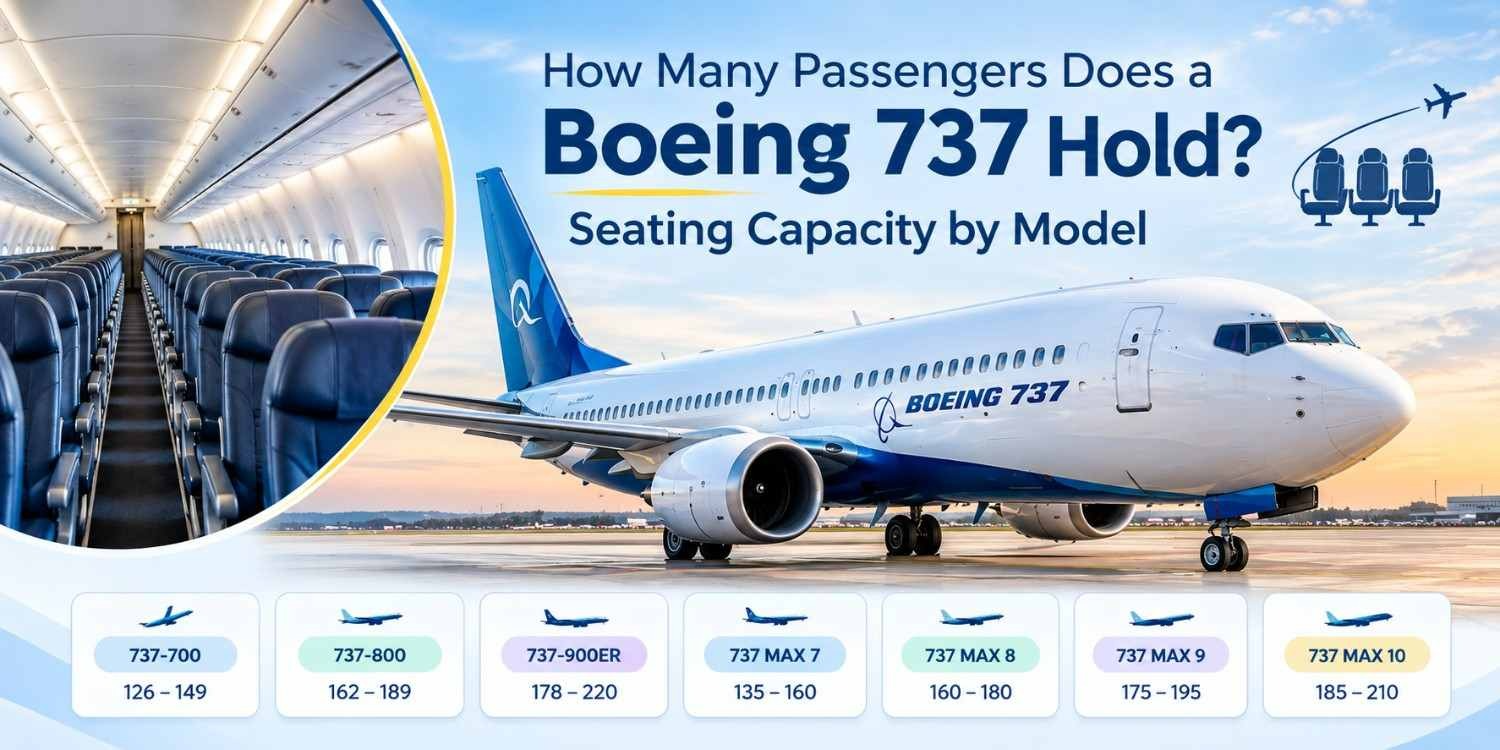
A Boeing 737 can seat from 130 to 210 passengers depending on model and airline seating configuration. Some high density configurations can carry more (Boeing 737 MAX 10 seats a maximum of 230 passengers).
The exact capacity depends on the aircraft variant, cabin layout (number of rows), seat spacing and number of travel classes.
Boeing 737 Seating Capacity by Model
Boeing has developed several generations of the 737, including the Classic, Next Generation (NG) and MAX families.
Here is a comparison of commonly recognised models.
These are indicative seating ranges based on typical cabin configurations. Actual airline layouts may differ. The MAX 10 can accommodate up to 230 passengers in its maximum-density configuration.
How Many Passengers Does a Boeing 737-800 Hold?
Boeing 737-800 is a Next Generation member used for short and medium haul operations.
It can seat about 162 passengers in a two-class configuration or up to 189 passengers in high density single class layout.
Airlines decide how they want to seat passengers based on operational requirements, passenger demand and the ratio of premium to economy seating.
In the U.S., 737-800 has been flown on domestic routes between major airports and regional destinations.
Its passenger capacity, range and operating characteristics have made it an aircraft of choice in airline fleet planning.
How Many Passengers Does a Boeing 737 MAX 8 Hold?
The Boeing 737 MAX 8 is a newer generation aircraft with new engines, better aerodynamics and modern cabin features.
Boeing says the MAX 8 can seat 160–180 passengers in two-class configuration and has a certified seating capacity of 210 passengers (depending on approved configuration).
The aircraft is built for short and medium haul operations so it is suitable for many domestic and international routes.
Passenger capacity has to be taken into account too (fuel consumption, flight distance, maintenance and aircraft utilisation). For airlines fuel efficiency has to be compared with fuel consumption; flight distance with flight time; maintenance costs with aircraft utilisation.
Which Boeing 737 Holds the Most Passengers?
Boeing 737 MAX 10 is the largest passenger-capacity variant of the 737 MAX.
It seats about 185–210 passengers in two-class configuration and a maximum of 230.
Its bigger cabin allows airlines to carry more passengers on high-demand routes.
But more seats don’t make an aircraft cheaper. Airlines have to take into account passenger load factors, route length, airport capacity and operating costs (total).
The MAX 10 was FAA certified in October 2026 and deliveries will start soon after.
Why Does Boeing 737 Passenger Capacity Vary?
Two Boeing 737 aircraft of the same model can carry different numbers of passengers.
Several factors influence seating capacity.
Cabin Configuration
Airlines may have economy only seating or first class, business class and economy all together. Premium cabins need more space per passenger.
Seat Pitch and Legroom
Seat pitch is the distance between corresponding points on consecutive rows. Higher seat pitch usually means fewer seats that can fit inside the cabin.
Airline Business Model
Low cost carriers usually have higher seating density and full service airlines may have more room for premium cabins and passenger amenities.
Aircraft Interior Layout
Lavatories, galleys, emergency exits and other cabin features affect approved seating arrangement.
The final passenger capacity must comply with aircraft certification and safety requirements.
Boeing 737 Seating Capacity and Aircraft Operating Costs
For airlines, aircraft owners and aviation investors seating capacity has a direct impact on financial planning.
A bigger plane will spread some of the operating costs over more passengers so cost per available seat is lower.
But economics depend on several other things too:
Fuel consumption and flight time.
Maintenance and engine costs
Crew and airport-related costs
Passenger load factor
Aircraft acquisition or leasing costs
Annual aircraft utilisation (e.g. an aircraft with 189 seats might have different operating economics when carrying 120 passengers than a nearly full flight).
Having passenger capacity as well as operating expenses lets aviation professionals know whether an aircraft is appropriate for a mission.
How Does the Boeing 737 Compare With a Boeing Business Jet?
Commercial Boeing 737 planes are designed to carry large numbers of passengers whereas BBJs have custom cabin configurations.
A Boeing BBJ 737 may have private lounges, conference areas, bedrooms and other amenities but has much less passenger capacity than an airline-operated 737.
For example, a BBJ for executive travel can carry about 19 passengers (although layouts vary).
This distinction matters when comparing commercial passenger capacity with operating costs of private aviation.
Unlike airline layouts, business jets are oriented towards cabin space, privacy, mission range and passenger comfort.
Compare Boeing 737 and Business Jet Operating Costs With AviaCost
Knowing how many people a Boeing 737 can carry is helpful but that’s only part of the evaluation process.
For aircraft buyers, operators and aviation professionals in the USA it is just as important to know ownership and operating expenses.
AviaCost has an aircraft cost calculator which enables users to explore estimated ownership and operating costs (fuel, maintenance, fixed costs, annual budgets etc.).
You can also compare up to five aircraft side by side to see how different models fit with your financial and operational needs.
Explore the Boeing BBJ 737 operating cost calculator to review aircraft specifications and estimated expenses.
Planning an aircraft purchase or comparing aviation operating costs?
Visit AviaCost to explore aircraft cost calculations, compare aircraft models and make more informed aviation decisions.
If you have questions about the calculator or need help using AviaCost’s tools contact the team via the website.
Note: Aircraft seating capacities are based on manufacturer specifications and representative airline configurations. Actual capacity varies by operator, cabin layout and aircraft certification. Operating cost estimates should be verified against current aircraft-specific information.