Is Aircraft Ownership the Key to Viable Operations in a Growing BizAv Market?
February 25, 2026
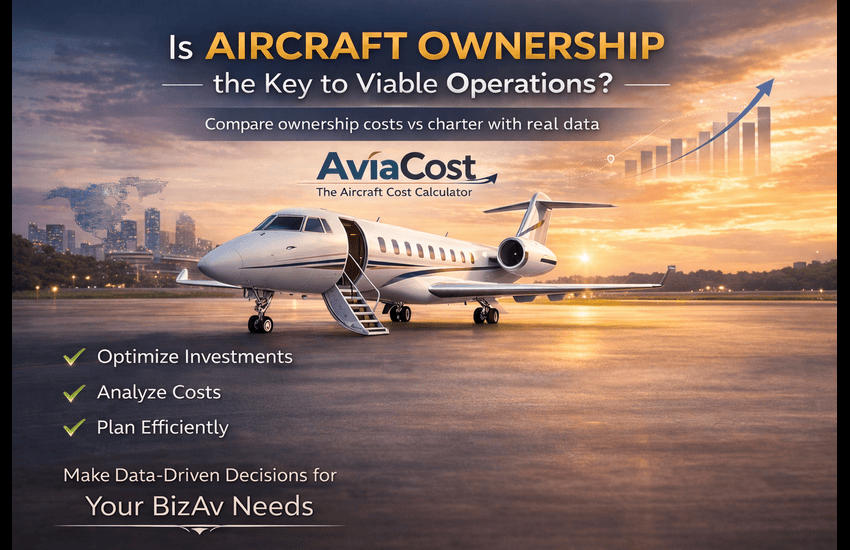
As business aviation (BizAv) grows worldwide, more and more operators are wondering whether aircraft ownership is a better long-term investment than renting or fractionalising access.
Platforms like AviaCost help people who make decisions answer this question with clear facts. AviaCost is a cloud-based service that makes it easier to buy and analyse aircraft by using accurate calculators, aircraft comparisons, and a database of information on more than 200 aircraft types.
The platform helps operators make smart choices about acquisition, operations, and lifecycle management by showing them cost drivers, modelling possibilities, and places where they can save money.
In a time when fleet investment, utilisation efficiency, and operating predictability are very important, knowing the real economics of ownership has become key to BizAv's long-term growth.
Is Aircraft Ownership More Economical Than On-Demand Access?
Ownership can boost your finances if it matches your purpose and usage.
• Based on 325 flying hours per year, a business jet can cost over $1.1 million to operate.
• These models show how fixed and variable costs, like fuel, maintenance, and hourly running costs, affect each other.
• Tools like AviaCost let operators test out different usage situations to see which has the best cost-per-hour results: ownership or charter.
To put it simply, ownership is rarely cheaper by default. It becomes cost-effective only when usage, route, and asset strategy are optimised.
Understanding the True Cost Structure of Ownership
There is a lot more to aircraft ownership than just the price you paid for it. A layered cost environment needs to be managed by operators.
Some important cost factors are:
• Fixed costs like crew, hangarage, and insurance.
• Costs that change based on usage, such as fuel use and upkeep.
• Hourly costs to run the plane, which, based on the type of plane, can be thousands of dollars.
Advanced aircraft analytics platforms help visualise these things, enabling operators to plan budgets and compare performance metrics such as range, cruise speed, and fuel use.
Companies risk underestimating lifetime costs if they don't use this kind of modelling.
Why Data-Driven Fleet Planning Is Becoming Essential
These days, BizAv workers use digital tools more and more instead of spreadsheets.
• AviaCost uses cost tools and side-by-side comparisons to determine which aircraft is better for a job and its ownership cost.
• Performance data like range, fuel consumption, and runway requirements helps match aircraft to actual needs.
This analytical approach helps people make better purchasing choices and keeps them from buying too much capacity.
Operational Efficiency: The Real Advantage of Ownership
When you own a business, you can make it more flexible than with charter plans.
• Dedicated planes make sure that availability is in line with business plans.
• Configuration based on mission helps both productivity and the passenger experience.
• Standardising fleet types can make operations more efficient, which has been seen in larger aircraft studies that look at fleet strategy.
For businesses that need to move frequently, this reliability means they can save time and better use their assets.
Market Signals Show Growing Interest in Ownership Models
Instead of relying only on charters, the BizAv ecosystem is moving toward hybrid ownership arrangements.
Matching aircraft type to the mission is what makes money.
The ability to afford to own an aircraft depends heavily on choosing the right type of plane.
There is a lot of variety in the examples from cost modelling platforms:
• Some turboprops and light jets can fly in the region cheaply because they use little fuel and don't have to follow strict runway standards.
• Larger planes made for flying between continents have more space, but they cost a lot more per hour to run.
This variety makes scenario-based analysis even more important before purchase.
Conclusion
Aircraft ownership isn't always necessary for BizAv businesses to be successful. Still, in a market that is growing and focusing on efficiency, it is quickly becoming a powerful strategic tool. Data is what really sets us apart. Operators can view ownership through an analytical lens rather than an assumption-based one, thanks to advanced platforms like AviaCost that enable precise modelling of acquisition and operating costs and alignment with goals.
AviaCost helps you make smarter choices about buying an aircraft. Using real operational data, you can compare prices, models, and ownership plans with certainty.
FAQs
Is owning an aircraft cheaper than chartering?
It depends on use. Owning a plane may be cheaper for frequent flyers, but chartering is cheaper for occasional flyers.
What are the biggest hidden costs in aircraft ownership?
Fixed costs, maintenance reserves, and fuel prices are the key cost elements besides the buying price.
How can operators evaluate whether to buy an aircraft?
Making smart decisions is possible with cost-analysis platforms that model utilisation, running costs, and aircraft performance.
Is fractional ownership replacing full ownership?
There are more and more fractional models that offer shared access while reducing capital exposure. However, for high-utilisation operators, full ownership is still important.
Why is data analytics important in BizAv today?
In today's aviation, making choices requires accurate predictions of costs and operating efficiency, which can be achieved only with powerful analytical tools.